This morning, September 29, 2026, I found myself going through some of my grandfather’s and great-grandfather’s old sermon notes—messages dating from the 1940s through the early 1970s.
Among those yellowing pages, I discovered a question written by my great-grandfather, Alex Smith, who pastored in Colorado and also traveled throughout the Rocky Mountains doing evangelistic work.
It was a simple question, but one that stopped me in my tracks:
Where Do My Sermons Go?
I was looking through stacks of old sermons, handwritten notes, Bible studies, and messages that had accumulated through the years.
Some were carefully typed. Others were scribbled on yellowing paper. Some had verses underlined, thoughts crossed out, and last-minute ideas written in the margins.
And there, among those piles of sermon notes, was this question:
Where do sermons go?
A sermon is preached on a Sunday morning, a Wednesday night, at a camp, around a campfire, at a funeral, or in a small gathering somewhere.
The preacher closes his Bible.
The people go home.
Another week begins.
But is that really where the sermon ends?
My great-grandfather was asking a much deeper question.
He was really asking:
“Where has the influence gone of all these sermons I have preached?”
What a question.
The truth is, we may never fully know.
Some sermons fall like rain on ground we may never see again.
Some become seeds.
A sentence is remembered during a difficult season.
A Scripture comes back to someone years later.
A young person sitting in the back row senses a call from God.
A marriage holds together because someone remembered one biblical truth.
A missionary goes to another nation.
A pastor decides to keep going.
A father changes the way he leads his family.
Someone comes to Christ.
And often, the preacher never hears about it.
The sermon is bigger than the sermon.
God’s Word has a life far beyond the notes sitting on a preacher’s desk.
Isaiah 55:11 reminds us that God’s Word does not return empty but accomplishes the purpose for which He sends it.
That means the effectiveness of a message cannot always be measured by what happened at the altar, how many people responded, how many people complimented the sermon, or how many views it received online.
Some of the greatest fruit may not appear until years later.
As I continued digging through those old sermon notes, I came across another stack.
Written across the top in large letters was one simple word:
“OVER.”
It almost sounded final.
The sermon is over.
The service is over.
The preacher’s work is over.
But then I turned the stack of sermon notes over.
And there, on the other side, I found my great-grandfather’s answer to the question:
“Where do sermons go?”
He had written:
“Where are last year’s sun rays? They have gone into fruits, crops, grains and vegetables to feed billions on the earth.
Where are last year’s raindrops? Forgotten by most people, of course, but they did their refreshing work, and their influence still does what it needs to do.
So, too, my sermons have gone into the lives of people and hopefully made them better people, more Christlike, and better fitted for Heaven.”
— Alex Smith, my great-grandfather
What a beautiful picture.
The sunlight disappears, but the fruit remains.
The raindrops vanish into the ground, but the harvest tells us they were there.
And perhaps sermons are much the same.
A preacher may never see where every word lands.
He may never know which sentence someone carried home, which Scripture stayed with them through a difficult season, or which message quietly redirected the course of a life.
But that does not mean the sermon disappeared.
It may have become fruit.
It may have become courage.
It may have become faith.
It may have become a calling.
It may have become another generation following Jesus.
Looking at these old notes reminds me that faithful preaching is a lot like planting trees under whose shade we may never sit.
We preach.
We teach.
We write.
We encourage.
We scatter the seed.
And then we trust God with where it goes.
These pages may eventually become brittle.
The ink may fade.
The preacher’s name may someday be forgotten.
But the Word of God keeps traveling.
Perhaps that is one of the beautiful mysteries of ministry: we rarely get to see the full reach of our obedience.
So, to every pastor, teacher, parent, small-group leader, missionary, and follower of Jesus who has ever wondered whether your words made a difference:
Keep opening the Bible.
Keep preparing.
Keep speaking truth.
Keep planting.
Keep trusting God with the harvest.
Because somewhere, someone may still be living from a word you shared years ago.
Where do sermons go?
Into hearts.
Into homes.
Into marriages.
Into ministries.
Into callings.
Into future generations.
And ultimately, into the purposes of God.
“So is my word that goes out from my mouth: It will not return to me empty…” — Isaiah 55:11
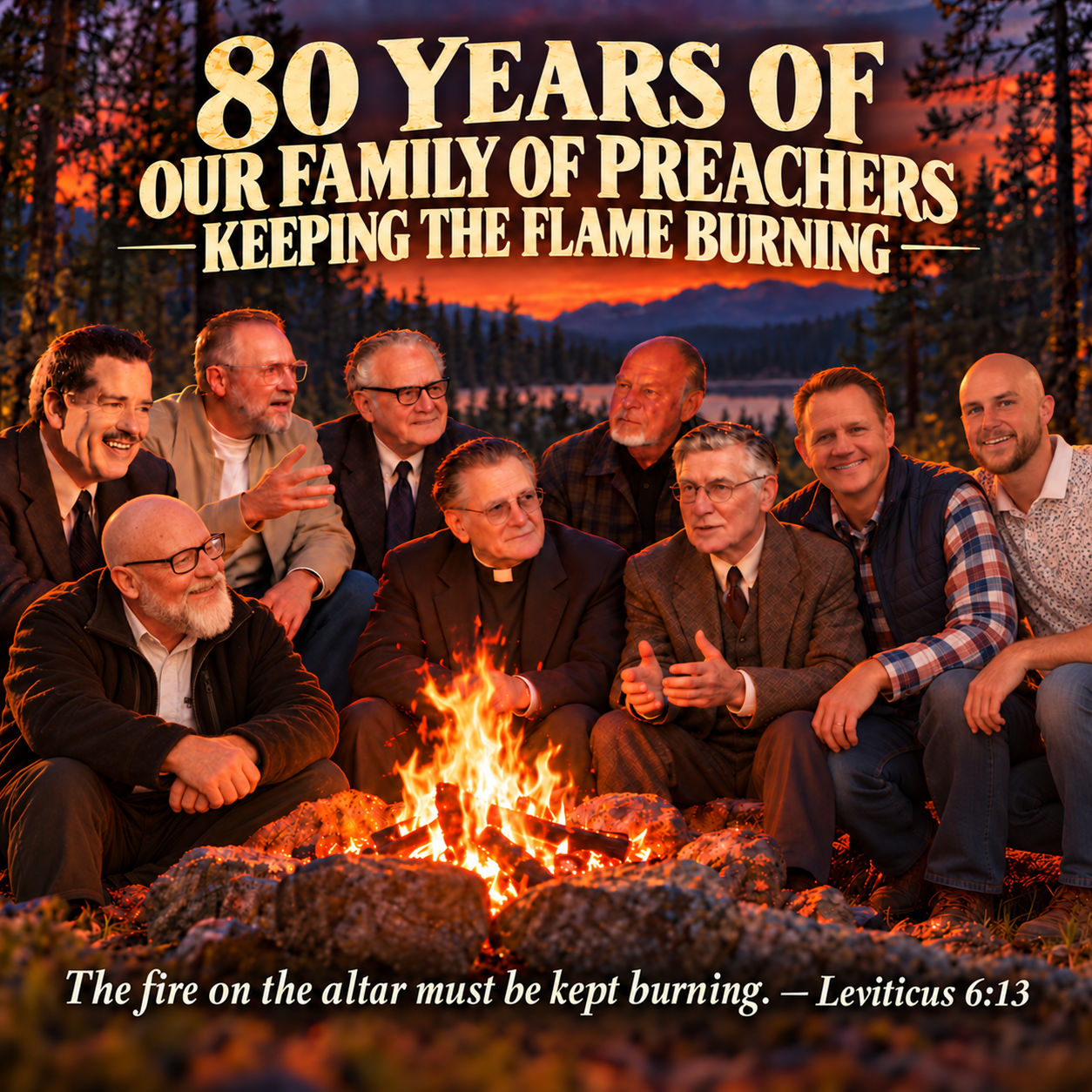
As I look back over more than 80 years of preaching, teaching, and ministry within our small family tribe of preachers, I am deeply grateful for the men who kept—and continue to keep—the flame of the Gospel burning.
I asked AI to help me create a picture representing the men in our family who have carried that flame from one generation to the next.
These were ordinary men who said yes to an extraordinary calling.
Some preached from pulpits.
Some preached in churches, revival meetings, small towns, and mountain communities.
Some have already finished their race.
Others are still carrying the torch.
But together, their lives remind me that the Gospel has a way of traveling from one generation to another.
Perhaps that is the answer my great-grandfather was looking for all those years ago.
Where did his sermons go?
Some of them came down through our family.
Some of them helped shape children, grandchildren, and great-grandchildren.
Some of them became faith.
Some became ministry.
Some became another preacher.
And more than 80 years later, the flame is still burning.
So today, I am grateful for men like Jim Adams, Ralph Hutchinson, Henry Lummer, Alex Smith, and the other pastors and preachers in our family who faithfully carried the Gospel before us—and for those of us who have the privilege of carrying it now.
The sermons may be over.
The pages may be old.
The voices may grow quiet.
But the influence continues.
The rain has fallen.
The sun has shone.
The seed has been planted.
And by the grace of God, the harvest is still coming in.
Thanks for your faithfulness pastor friends…. you ARE making a difference and remember to play the LONG game.
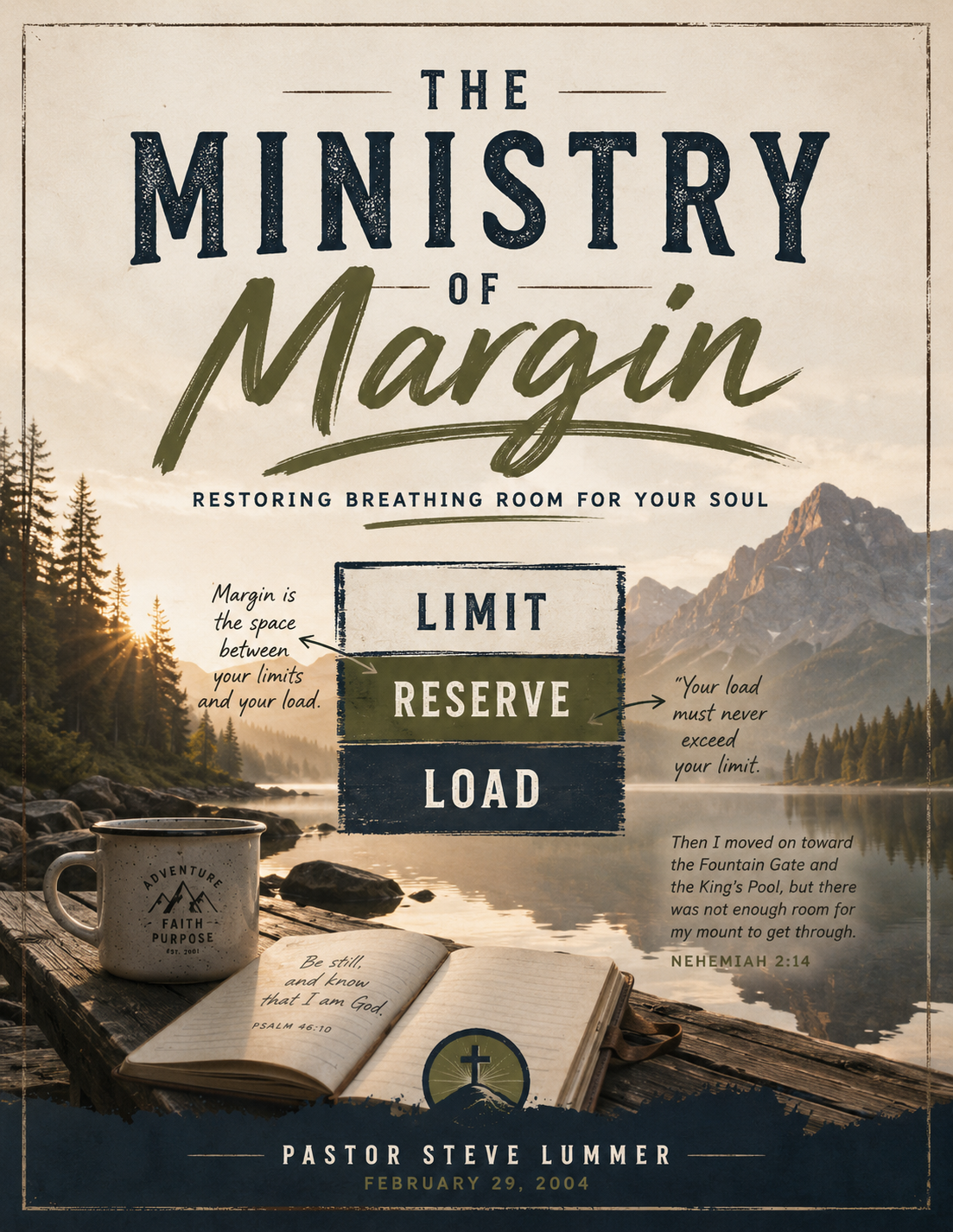
“Then I moved on toward the Fountain Gate and the King’s Pool, but there was not enough room for my mount to get through.” Nehemiah 2:14
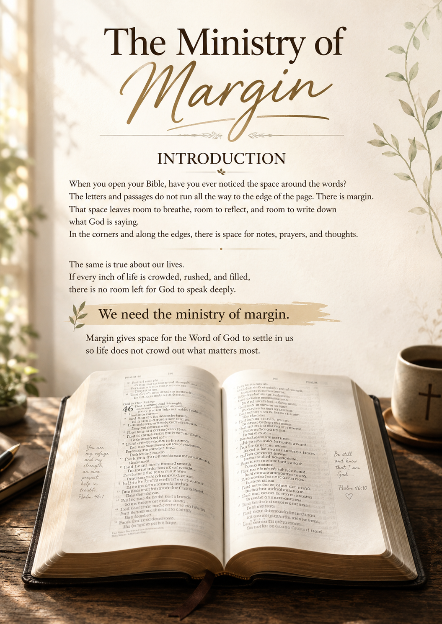
Introduction
We live in a culture that celebrates full calendars, constant accessibility, and endless productivity.
We’re praised for being busy.
We wear exhaustion like a badge of honor.
Yet God never designed us to live overloaded.
The greatest threat to your vision is often not failure…
It’s fatige.
Today I want to talk about The Ministry of Margin.
Margin is the space between your limits and your load.
Think of it like this:
LIMIT
RESERVE
LOAD
Your load must never exceed your limit.
The reserve between the two is called margin.
Without margin…
Vision disappears.
Joy fades.
Relationships suffer.
Spiritual sensitivity declines.
I. The Overload Syndrome
“The spirit is willing, but the flesh is weak.”
Matthew 26:41
Signs of overload
Constant exhaustion
Irritability
Avoiding people
Feeling behind
No room to think
Living in survival mode
The problem isn’t simply working hard.
The problem is living with no reserve.
Accessibility has become one of our greatest enemies.
Phones.
Email.
Texts.
Notifications.
Social media.
Everyone has immediate access to us.
Just because someone can reach you…
doesn’t mean they should.
Hurry Sickness
John Ortberg tells the story of asking Dallas Willard,
“What must I do to become spiritually healthy?”
Willard answered,
“You must ruthlessly eliminate hurry from your life.”
Ortberg wrote it down.
Then asked,
“What else?”
Willard smiled.
“There is nothing else.”
Hurry is not simply the pace of life.
It is the condition of the soul.
II. Learn to Read Your Reserve Gauges
Every relationship either:
Adds to your reserves
or
Subtracts from your reserves.
Ask yourself:
Who energizes me?
Who is neutral?
Who consistently drains me?
Not every difficult person should be avoided.
But Scripture repeatedly teaches wisdom about boundaries.
Proverbs 4:23
“Above all else, guard your heart…”
Protect your emotional reserves.
You cannot pour from an empty cup.
III. Six Ways to Create Margin
1. Spend Time with People Who Charge Your Battery
“A sweet friendship refreshes the soul.” Proverbs 27:9 (The Message)
Life is built on relationships.
Isolation kills.
Encouragement restores.
Ask yourself:
Who leaves me more alive after spending time together?
Spend more time there.
2. Leave Room for Margin
Richard Swenson defines margin as
“the space between our load and our limits.”
Margin is breathing room.
Nature even teaches this.
Trees produce thousands of seeds.
Fish lay millions of eggs.
God designed creation with surplus.
Even Jesus modeled margin.
When He fed the 5,000…
There were twelve baskets left over.
Margin leaves room for
ministry
mercy
generosity
interruption
miracles
3. Reserve Down Time
Sabbath isn’t laziness.
It’s wisdom.
Bill Hybels once confessed,
“The pace at which I was doing the work of God was destroying the work of God in me.”
Genesis says God worked six days…
and rested one.
Not because He was tired.
But because He was teaching rhythm.
Creation.
Rest.
Creation.
Rest.
Healthy souls breathe in rhythm.
4. Plan for Lead Time
Failure to plan…
is planning to fail.
The bigger the vision,
the more lead time it requires.
God always plans ahead.
Ephesians reminds us that before the foundation of the world…
God already had a plan.
Without lead time:
There is no creativity.
There is no vision.
There is only reaction.
Great leaders don’t simply react.
They prepare.
5. Seek Solitude
Jesus repeatedly withdrew.
Mark 1:35
“Very early in the morning… Jesus went to a solitary place.”
Dallas Willard said,
“The answer to busyness is not more efficiency. It is solitude.”
You cannot hear God clearly in constant noise.
Solitude gives us
altitude
perspective
clarity
Every leader needs a mountain.
Every believer needs a quiet place.
6. Find Your Sacred Space
Henri Nouwen writes,
“Discipline is creating space in which God can act.”
Moses had the Tent of Meeting.
Jesus had lonely places.
Where is yours?
For some it’s
a trail
a river
a canoe
a campfire
a mountain bike
a chair on the porch
a prayer room
You need a place where heaven regularly meets earth.
The Outdoor Nations Connection
One of the reasons Outdoor Nations exists is because margin is easier to discover outdoors.
The trail slows us.
The river teaches rhythm.
The campfire quiets our hearts.
The mountain reminds us we are not God.
When we step outside…
God often speaks to our inside.
Sometimes the greatest spiritual discipline isn’t learning another Bible study.
It’s simply creating enough space to hear the One who has been speaking all along.
Conclusion
The enemy doesn’t always destroy vision through sin.
Sometimes…
he simply crowds it out.
Your calendar becomes too full.
Your soul becomes too hurried.
Your heart becomes too noisy.
Vision suffocates when there is no margin.
God is inviting us back to breathing room.
Back to reserve.
Back to Sabbath.
Back to solitude.
Back to sacred spaces.
Back to relationships that restore us.
Because the ministry God wants to do through you…
begins with the margin He first creates within you.
Closing Challenge
This week, ask yourself three questions:
Where am I overloaded?
What is stealing my margin?
What one change can I make this week to create breathing room for God?
Final Scripture
“Be still, and know that I am God.” — Psalm 46:10
THE MINISTRY OF MARGIN
Conclusion: There Is Room at the Cross
Key Text
“Then I moved on toward the Fountain Gate and the King’s Pool, but there was not enough room for my mount to get through.” Nehemiah 2:14
Throughout this message we’ve talked about creating margin in our schedules, our relationships, our souls, and our vision.
But perhaps the greatest margin of all is the margin God has created for us through His grace.
Isn’t that really why the Church exists?
To offer a margin of grace to people who have no margin left in life.
Every week people walk through our doors carrying impossible loads.
Some are exhausted.
Some are overwhelmed.
Some are buried under guilt.
Some are trying to hold together broken marriages, broken dreams, broken finances, or broken hearts.
Like Nehemiah, they long to move toward the Fountain Gate and the King’s Pool—the very places where life and refreshment are found—but there simply isn’t enough room.
Life has become so cluttered that there is no space left for God.
Too many people have crowded out the most important relationship they will ever have because of all the trivial things demanding their attention.
Yet the Gospel announces wonderful news.
Jesus has already made room.
At the cross, He created enough margin for every failure, every regret, every sin, and every burden we could ever carry.
Romans 5:20 reminds us:
“Where sin increased, grace increased all the more.”
His mercy is greater than your mistakes.
His grace is bigger than your failures.
His love has no limits.
If you’ve never trusted Christ, or if you’ve wandered far from Him, today there is room for you.
Come to the cross.
Lay down your overload.
Lay down your hurry.
Lay down your shame.
Lay down your striving.
Receive the margin that only Jesus can give.
Because His invitation has never changed:
“Come to me, all you who are weary and burdened, and I will give you rest.” —Matthew 11:28
Final Challenge
This week, don’t simply create more room in your calendar.
Create more room for Christ.
Remember:
Margin creates space for vision.
Margin creates space for relationships.
Margin creates space for rest.
Margin creates space for ministry.
And ultimately, God’s grace creates margin for your soul.
Closing Prayer
“Lord, teach us to live with margin—not simply so we can accomplish more, but so we can become more like You. Give us the wisdom to leave room for Your Spirit to work in our lives. May our homes, our schedules, our relationships, and our hearts have enough margin for Your presence. Thank You that at the cross there was—and always will be—room for us. In Jesus’ name, Amen.”
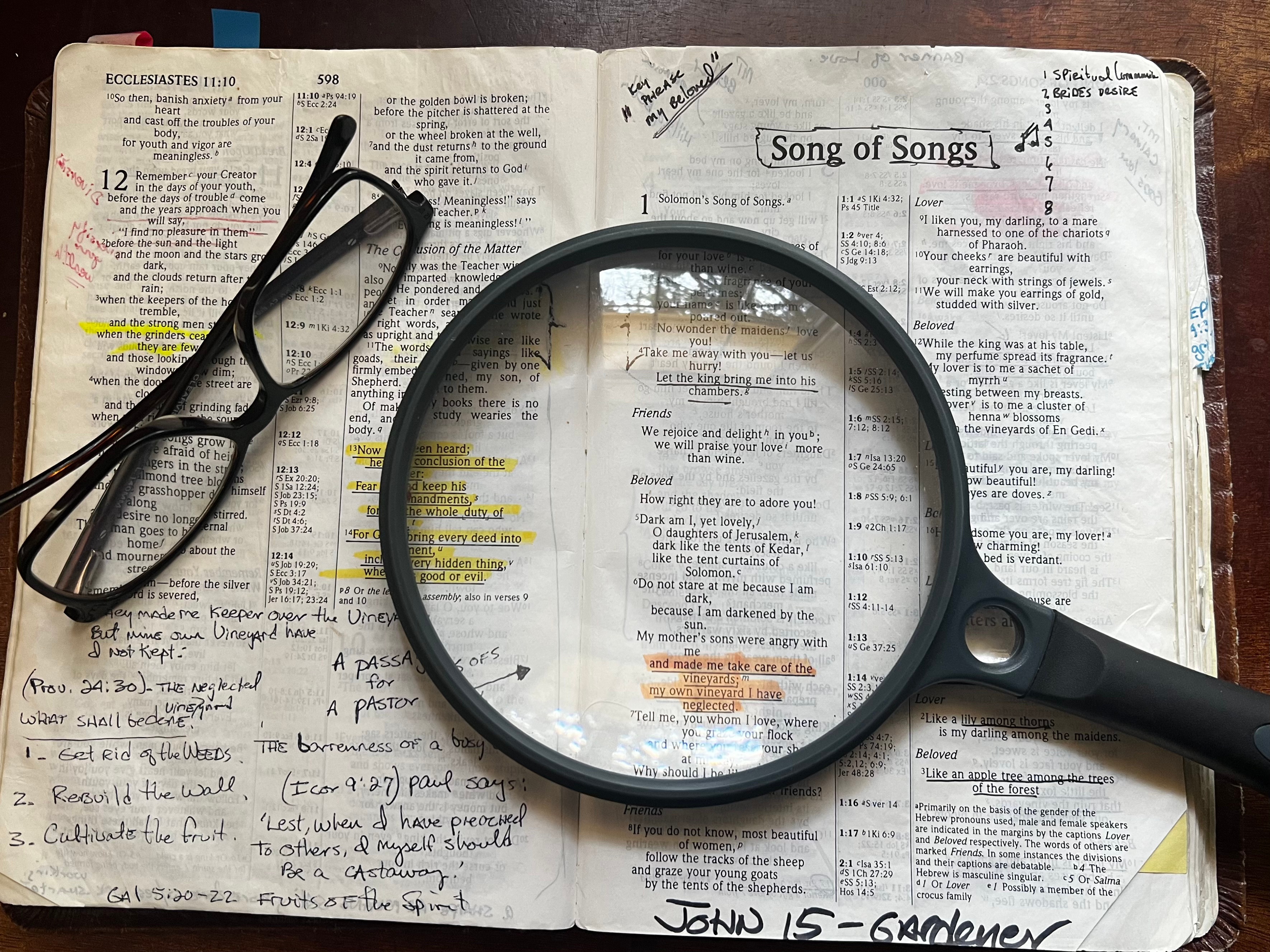
Over the past three years, I have found myself walking through a season I was not fully prepared for—a season marked by the slow grief of aging, the nearness of death, and the painful responsibility of caring for those I deeply love. As I have served my parents and dear relatives in their later years, I have watched strength fade, memories weaken, bodies grow tired, and life begin its quiet return toward the dust. These experiences have not only brought sorrow, but also deep reflection. They have caused me to wrestle honestly with the meaning of old age, the brevity of life, and the hope we are called to hold onto when death draws near.
Because of this, I wanted to turn to Scripture and ask what God says about these difficult but unavoidable realities. The book of Ecclesiastes, especially Ecclesiastes 12:1–7, speaks with a sobering honesty about aging and death. It does not avoid the pain of human frailty, nor does it pretend that life lasts forever. Instead, it calls us to remember our Creator before the difficult days come. This paper that I have submitted for my Masters program at Yellowstone Theological is my attempt to reflect on Ecclesiastes through the lens of my own lived experience, allowing the wisdom of Scripture to speak into the grief, questions, and holy wrestling that come when we stand near the edge of life and eternity.
I hope this helps others who may be wrestling through some of the same questions.
YELLOWSTONE THEOLOGICAL INSTITUTE
Exegetical Paper
Ecclesiastes 12:1-7
A PAPER PRESENTED TO
DR. BRETT DESPER
BY
Steve Lummer
MAY 2026
Remember Your Creator Before You Bite the Dust
An Exegetical Paper on Ecclesiastes 12:1–7
“Remember your Creator in the days of your youth, before the days of trouble come
and the years approach when you will say, “I find no pleasure in them”—
2 before the sun and the light and the moon and the stars grow dark, and the clouds return after
the rain; 3 when the keepers of the house tremble, and the strong men stoop, when the grinders
cease because they are few, and those looking through the windows grow dim;
4 when the doors to the street are closed and the sound of grinding fades; when people rise up at
the sound of birds, but all their songs grow faint; 5 when people are afraid of heights and of
dangers in the streets; when the almond tree blossoms and the grasshopper drags itself along and
desire no longer is stirred. Then people go to their eternal home, and mourners go about the
streets. 6 Remember him—before the silver cord is severed, and the golden bowl is broken;
before the pitcher is shattered at the spring, and the wheel broken at the well,
7 and the dust returns to the ground it came from, and the spirit returns to God who gave it.”
1Ecclesiastes 12:1-7 (NIV) the Holy Bible
Ecclesiastes 12:1–7 is not merely a poem about growing old; it is a sacred
summons to remember the Creator before life’s strength fades. The passage teaches that wisdom
is not found in denying death but in living faithfully before God while breath, strength, and
opportunity remains.
This section of Ecclesiastes is one of the most poetic and practical passages in the Old
Testament. It reads like an old trail guide standing at the edge of the Grand Canyon, pointing
down the path and saying, “Pay attention now, because the trail gets steeper the further down
you go than you think.” The passage urges the reader to “remember your Creator in the days of
your youth” before the “days of trouble” arrive. In a few short verses, the Teacher (Qoheleth,
often translated “the Preacher” or “the Teacher.”) gives us a vivid picture of aging, frailty,
mortality, and the certainty that every human life eventually returns to dust.
This passage is not meant to depress us, it is meant to wake us up. Ecclesiastes 12
does not simply say, “You are going to die.” It says, “Because you are going to die, learn how to
live.” The Teacher wants us to remember God before life becomes tangled in regret, weakness,
fear, and loss. He wants us to build our lives around the Creator before the body begins to break
down, and the opportunities of youth pass away like morning mist in the mountains.
The main idea of Ecclesiastes 12:1–7 is that human beings must remember and honor their
Creator before the decline of old age and the certainty of death reveal how fragile life truly is.
The passage calls for more than mental recollection. To “remember” the Creator is to live in
reality, awareness, humility, worship, obedience, gratitude, and dependence. The Teacher is
calling the young—and really every generation—to live with God in view before the dust
returns to the earth and the spirit returns to the God who gave it.
This paper will examine Ecclesiastes 12:1–7 by considering its literary context, historical
background, key words, imagery, theological message, and personal practical significance.
The passage is a wilderness warning and a gracious invitation. It tells us that life is a gift, youth
is a stewardship, aging is a teacher, death is a boundary, and God is the One who gives meaning
to the whole journey.
Literary and Historical Context
Ecclesiastes belongs to the wisdom literature of the Old Testament. Alongside Job,
Proverbs, and Song of Songs. Ecclesiastes wrestles with the meaning of life under God.
The book is traditionally associated with Solomon because of the opening description: “The
words of the Teacher, son of David, king in Jerusalem” (Eccl. 1:1). Whether Solomon himself
wrote the book directly or whether a later wisdom teacher wrote in a Solomonic tone, the voice
of Ecclesiastes speaks with royal authority, broad experience, and deep reflection.
2“Traditionally Qoheleth has been identified as Solomon.”
According to Tremper Longman, 3the speaker is called Qoheleth, often translated as “the
Teacher” or “the Preacher.” The Hebrew word carries the idea of one who gathers an assembly
or speaks before a gathered people.
Qoheleth is not merely giving private journal reflections. He is addressing the community. He
is calling people to consider the world honestly, without religious phrases and without
pretending life is easier than it is.
One of the key phrases in Ecclesiastes is “under the sun.” This phrase describes life from an
earthly perspective—life observed in the ordinary world of labor, pleasure, injustice, time,
aging, and death. The Teacher looks at everything people chase wisdom, wealth, work,
pleasure, reputation and success. Again and again, he calls these things “vanity” or
“meaningless,” using the Hebrew word hebel. This word does not always mean that life has no
value. It often means that life is vapor-like, temporary, elusive, and impossible to fully control.
4“Ecclesiastes dismantles the proud towers of human certainty.”
Ecclesiastes is not a book of despair. It is a book of stripped-down honesty. It clears away false
hopes so that true wisdom can stand. The Teacher is like a wilderness guide who removes the
unnecessary gear from your pack because he knows the mountain will expose what you are
carrying. Ecclesiastes teaches that if we build life only on what we can see, touch, earn, achieve,
or control, we will eventually discover that everything slips through our fingers. But if we
receive life as a gift from God and live in reverent fear before Him, we can find joy even in a
world marked by mystery and mortality.
The Command to Remember the Creator (vs 1)
Ecclesiastes 12:1 begins, “Remember your Creator in the days of your youth, before the days of
trouble come and the years approach when you will say, ‘I find no pleasure in them.’” The
command is simple, but it is loaded with meaning. To “remember” in Scripture means more than
recalling information. Biblical remembering often involves action, loyalty, and covenant
faithfulness. When God “remembers” His people, He acts on their behalf. When Israel is told to
remember the Lord, they are called to live in obedience and worship.
So when the Teacher says, “Remember your Creator,” he is not saying, “Do not forget that God
exists.” He is saying, “Build your life around the One who made you.” Remembering the
ourselves into existence. We did not breathe life into our own lungs. We are creatures, not
creators. We are stewards, not owners. We are pilgrims, not permanent residents.
The word “Creator” is important. The Teacher does not merely say, “Remember God,” though
that would certainly be true. He says, “Remember your Creator.” This grounds the command in
creation itself. God is the Maker of life, the Giver of breath, the Designer of the human body,
and the One who formed both dust and spirit. This passage begins with the Creator and ends
with the body returning to earth and the spirit returning to God. The structure reminds us that the
whole human story begins and ends in the hands of God.
“Before the Days of Trouble Come” (vs 2)
In light of watching my parents transition from healthy vibrant people to being totally dependent
on others was a reminder of this passage. The first “before” in the passage introduces urgency.
The Teacher says to remember the Creator “before the days of trouble come.” These “days of
trouble” refer to the hardships associated with aging, decline, and approaching death. The
Teacher is realistic. Life is beautiful, but it is also hard. The body is a gift, but it is also
temporary. Strength is real, but it does not last forever.
The phrase “when you will say, ‘I find no pleasure in them’” points to a season when life’s joys
become harder to access. This does not mean old age is only misery. Many older people possess
deep joy, wisdom, peace, and spiritual richness. But Ecclesiastes is naming the honest
difficulties that come with aging. There are seasons when the body hurts, friends are gone,
independence is reduced, and ordinary pleasures are shadowed by limitations.
The Darkening of the Lights (Vs 2)
Ecclesiastes 12:2 continues, “before the sun and the light and the moon and the stars grow dark,
and the clouds return after the rain.” This verse shifts into poetic imagery. The lights of the sky
grow dim. The normal signs of brightness, guidance, beauty, and rhythm begin to fade. The
image may describe the dimming of life’s vitality or even the loss of eyesight. It may also speak
more broadly of the emotional and physical gloom that can accompany aging.
The sun, moon, and stars are creation lights. They mark time and season. They give orientation
to travelers. Anyone who has been out under a desert sky or paddled a river under the stars
knows how much light matters. When the lights grow dark, the world feels different. The path is
harder to see. The horizon disappears. The confidence of movement gives way to caution.
This image is deeply human. It describes the cumulative nature of aging. The Teacher is not
mocking the elderly. He is honoring their struggle. He is saying that a time may come when life
feels like one storm after another. Therefore, remember the Creator before the sky darkens.
The Keepers of the House Tremble (vs 3)
Ecclesiastes 12:3 says, “when the keepers of the house tremble, and the strong men stoop.” The
“house” is likely a metaphor for the human body. The “keepers of the house” may refer to the
arms and hands, which protect, work, hold, build, cook, write, carry, and serve. In old age, these
keepers tremble. Hands that once swung a hammer, gripped handlebars, held children, served
communion, cooked meals, or tied fishing knots may begin to shake.
The “strong men” may refer to the legs, shoulders, or back. They stoop. The body that once
stood tall begins to bend. The posture changes. The stride shortens. Strength gives way to
caution. The uphill climb takes longer than it used to. The pack feels heavier. The trail that once
felt easy now demands attention.
This image is powerful because it recognizes the body as a house. We live in our bodies. We
experience the world through them. We work, worship, love, serve, and adventure through these
physical frames. But the house ages. The beams sag. The walls weaken. The hinges stiffen. The
roof leaks. The body is good, but it is not permanent.
For people of faith, this should not create contempt for the body. Christianity does not teach that
the body is worthless. The body is created by God and will one day be raised. But Ecclesiastes
reminds us that the present body is mortal. It is a tent, not the final home. The trembling of the
keepers is a message preached through flesh: “Remember your Creator.”
The Grinders Cease and the Windows Grow Dim vs 3b)
The verse continues, “when the grinders cease because they are few, and those looking through
the windows grow dim.” The “grinders” almost certainly refer to teeth. In the ancient world,
dental loss was common in old age. The image is domestic and earthy. A household with fewer
grinders produce less. In the same way, a mouth with fewer teeth struggles to chew.
This is wisdom literature, at its most honest truth. It does not speak of aging in abstract terms. It
brings it down to the daily realities of eating, seeing, walking, and hearing. The Teacher says
that remembering the Creator is not just a spiritual idea floating above life. It is connected to the
body at the most ordinary level.
The “windows” likely refer to the eyes. Those who look through the windows grow dim. Sight
fades. The world blurs. Faces become harder to recognize. Words on the page grow smaller.
The trail ahead becomes less clear. The loss of vision is not only physical; it can also symbolize
the narrowing of life’s possibilities.
The Teacher’s imagery is tender but unflinching. He is reminding us that the faculties we often
take for granted are gifts. We usually do not appreciate these gifts until they begin to fail.
The Doors Are Shut and the Sound of Grinding Fades (vs 4)
Ecclesiastes 12:4 says, “when the doors to the street are closed and the sound of grinding fades.”
This may refer to the ears becoming dull or to a person withdrawing from public life. The doors
that once opened outward begin to close. The sounds of daily activity faint.
Aging can bring isolation. The person who once moved easily through the community may
become more homebound. The world outside still moves, but access to it becomes limited. The
sound of grinding—perhaps the sound of millstones and daily labor—fades. Life becomes
quieter, not always by choice.
There is a word of ministry here. Ecclesiastes 12 does not only teach young people to remember
God. It also teaches the community to remember the elderly. When the doors close and the
sounds fade, the people of God should not forget those who are aging.
The verse continues, “when people rise up at the sound of birds, but all their songs grow faint.”
This may describe sleeplessness in old age. The elderly may wake early, even at the sound of
birds. Yet the songs grow faint, possibly meaning hearing loss or the fading of music and joy.
The world is still singing, but the aging person may not hear it as clearly.
This again presses the urgency of the passage. Listen to the birds while you can. Hear the music
of creation while your ears are open. Receive the joy of God’s world while the senses are alive.
Do not wait to worship until the songs grow faint.
Fear of Heights and Danger on the Road (vs 5)
Ecclesiastes 12:5 says, “when people are afraid of heights and of dangers in the streets.” The
boldness of youth gives way to fear and vulnerability. Heights that once thrilled now threaten.
Streets that once seemed ordinary now feel dangerous. Aging can shrink a person’s world not
only because of physical limitation but also because of increased fear.
This is another honest observation. When the body weakens, risks feel different. A fall is no
longer a small accident; it can change everything. A crowded street can feel overwhelming. A
simple outing can require planning, help, and courage. The Teacher understands that aging
affects not only strength but confidence. Aging removes the illusion that we are self-sufficient.
The Almond Tree Blossoms, the Grasshopper Drags, and Desire Fails (vs. 5)
The same verse continues with three memorable images: “when the almond tree blossoms and
the grasshopper drags itself along and desire no longer is stirred.” The almond tree was known
for its white blossoms. Many interpreters see this as a picture of white hair in old age. The head
blossoms like an almond tree. What once was dark becomes white. The body carries the visible
signs of time.
The grasshopper dragging itself along is almost humorous but also sad. A grasshopper is
normally a creature of quick movement and sudden leaps. But here even the grasshopper drags.
This likely pictures the slowing of movement in old age. The spring is gone from the step. The
body that once leaped now shuffles.
These images work together powerfully. The almond tree blossoms above, the grasshopper
drags below, and desire fades within. Aging touches appearance, movement, and inner appetite.
No part of human life remains untouched by time.
Humanity Goes to Its Eternal Home (vs 5b)
Ecclesiastes 12:5 then gives the reason for all this imagery: “Then people go to their eternal
home and mourners go about the streets.” The passage has been moving toward death, and now
death comes into full view. The aging person goes to his “eternal home,” and the mourners
gather.
The mourners in the street remind us that death is both personal and communal. When one
person dies, others grieve. In the ancient world, mourning was often public and visible. The
streets themselves carried the sound of loss. Death interrupts the whole community.
This is important because our modern world often tries to privatize grief. We hide death in
hospitals, funeral homes, and quiet announcements. But Ecclesiastes brings death into the street.
It says, “Look at it. Do not pretend this is not part of life.” Wisdom requires that we face death
honestly.
The Silver Cord, Golden Bowl, Pitcher, and Wheel (vs.6)
Ecclesiastes 12:6 says, “Remember him—before the silver cord is severed, and the golden bowl
is broken; before the pitcher is shattered at the spring, and the wheel broken at the well.” The
command to remember is repeated. This repetition is important. The Teacher circles back to the
main point: remember Him before death comes.
Together, these images suggest the final breakdown of life’s fragile mechanisms. The light goes
out. The water vessel breaks. The wheel stops turning. The household of the body can no longer
function.
The beauty of the images makes the reality more sobering. The cord is silver. The bowl is
golden. Human life is precious. The body is not trash; it is treasure. The tragedy of death is not
that something worthless is discarded, but that something valuable is broken. Ecclesiastes
honors human life by describing it with precious materials.
this passage recognizes that death is now a universal boundary. Everyone’s cord will one day be
severed. Everyone’s bowl will one day break.
The question is whether we have remembered the Creator before that day.
Dust Returns and the Spirit Returns (vs. 7)
Ecclesiastes 12:7 concludes, “and the dust returns to the ground it came from, and the spirit
returns to God who gave it.” This verse echoes Genesis 2:7, where God forms the man from the
dust of the ground and breathes into him the breath of life. Ecclesiastes brings the reader back to
creation. Human beings are dust animated by divine gift. We are earth and breath. We are
material and spiritual. We are lowly and glorious at the same time.
5“death occasion a remarkable distinction between humans and beast. Whereas dust returns to
the earth, human breath ascends to God, who gave it.”
The body returns to the ground. This is not a metaphor only; it is a physical reality. The human
frame, made from the elements of the earth, returns to the earth. Every funeral testifies to this
truth. The strongest body, the most beautiful face, the most disciplined athlete, the hardest
worker, the wealthiest ruler, and the poorest laborer all share the same earthly end.
6The book has some other biblical connections, Ecclesiastes 12:7 also says, “the spirit returns to
God who gave it.” This again connects to Genesis 2:7, where God breathes life into humanity.
The body returns to the earth, but the life-breath belongs to God. This verse reminds the reader
that human life begins with God and ends before God. We are not independent creatures; we are
dependent on the One who gives life, breath, and meaning.
But the spirit returns to God who gave it. Life is not self-originating. The breath within us is
entrusted by God. At death, the gift returns to the Giver. This does not answer every question
about the intermediate state or the final resurrection, but it clearly places human destiny in
God’s hands.
7“Ecclesiastes as wisdom literature that resists easy answers and forces the reader to live
faithfully within mystery. In this way, Ecclesiastes 12 teaches that wisdom is not denial of death
but faithful living in light of death.”
Practical Application
The application is for the young: do not waste your youth. Youth is not just a time for self-
expression; it is a time for spiritual formation. Remember God while your mind is sharp, your
body is strong, your options are many, and your habits are still being shaped. Give God more
than the leftovers of your life. Give Him your first strength.
Ecclesiastes 12:1–7 is no longer just ancient poetry to me; it has become deeply personal. Over
the past three years, while serving as trustee and power of attorney for my mom, dad, and Aunts
estate, I have watched people I love move from strength and vitality into the difficult realities of
aging. Their slowing steps and weakening bodies have become a living reminder of Solomon’s
words. Ecclesiastes 12 speaks honestly and tenderly about life’s fading strength, calling us to
“remember our Creator” before the difficult days come.
Today, at 68, I would tell my 17-year-old self: Remember your Creator while your legs are
strong, your eyes are clear, and your dreams are still running wild—because one day the trail
will slow, but the One who called you will still be faithful.
Conclusion
8“There is nothing pleasant about old age and death, regardless of how one approaches this
text.”
Ecclesiastes 12:1–7 is a holy wake-up call. It tells us to remember our Creator before the days of
trouble come. It paints the aging body with unforgettable images: trembling keepers, stooping
strong men, few grinders, dim windows, closed doors, faint songs, fear of heights, blossoming
almond trees, dragging grasshoppers, broken bowls, shattered pitchers, and dust returning to
earth.
The passage is beautiful because it is honest. It does not flatter youth or deny aging. It does not
hide death or exaggerate human strength. It simply tells the truth: life is a gift from the Creator,
and that gift must be received with reverence before it passes.
To me, Ecclesiastes 12 feels like a word spoken around a late-night campfire after a long day on
the trail. The flames are low. The stars are bright. The old guide leans forward and says, don’t
wait until your legs are gone to choose the right trail. Don’t wait until the light fades to look for
the One who made the sun. Don’t wait until the dust settles to remember where your breath
came from.
The Creator is not only waiting at the end of the trail. He is the One who has been walking with
us from the beginning.
Bibliography
Crenshaw, James L. Old Testament: An Introduction. 3rd ed. Louisville: Westminster John Knox Press, 2010.
Crenshaw, James L. “Youth and Old Age in Qoheleth.” Hebrew Annual Review 10 (1986): 1–12.
Fox, Michael V. A Time to Tear Down and a Time to Build Up: A Rereading of Ecclesiastes. Grand Rapids: Eerdmans, 1999.
Longman III, Tremper. The Book of Ecclesiastes. New International Commentary on the Old Testament. Grand Rapids: Eerdmans, 1998.
Seow, Choon-Leong. Ecclesiastes: A New Translation with Introduction and Commentary. Anchor Bible 18C. New York: Doubleday, 1997.
Zondervan Academic. “Who Wrote Ecclesiastes and What Does It Mean?” October 21, 2017.
The Holy Bible, New International Version. Grand Rapids: Zondervan, 2011.
At 42 years of age, I decided to face my mid-life crisis head-on—by restoring a 1972 Porsche 914-6.
Because sometimes you don’t need answers. You need a garage, a classic engine, and a project that reminds you what it feels like to build something with your hands.
When I turned 40, I started looking for hobbies. I called them “healthy diversions.”
Pastoral ministry can be incredibly meaningful—but it can also be hyper-stressful. Instead of crashing, burning, or making questionable life choices, I decided to lean into something tangible, real, and life-giving. Clean, healthy hobbies. Honestly, every pastor/man needs a few of those.
Mine started with a little 1970s sports car I found sitting in a mechanic’s lot in St. Charles, Missouri. The project began in the year 2000, right in the middle of what people back then loved to call a “mid-life crisis.” Whatever that means.
What it meant for me was hours of sanding, prepping, restoring, and dreaming in an old workshop a friend let me use. That little yellow car became my therapy, my thinking space, my creative outlet—and probably my cheapest counselor.
Eventually, I made it through my so-called mid-life phase and sold the car… and I think I broke even (heavy emphasis on think 😂).
Below is the original eBay listing I wrote when I sold it. at the age of 67, these photos still makes me smile.
Listed below is the description pf my add on eBay.
This is a 1974 CLEAN/NO RUST 914 converted to a 914/6 with a 1972 2.2 911 Porsche motor totally rebuilt motor with receipts.2.2 .
This is a 1974 914 converted into a 914/6 2.2 Porsche motor. – The motor is a 1972 rebuilt engine that runs great.The motor was completely rebuilt from a line bore up.The mechanic: Walt’s V.W. in Columbia, Missouri. (all the documents/invoices of Walt’s work are available.)
Weber carbs are in great shape.The car was repainted in 2003 a Viper race yellow. ( there are a few chips and markings on the vehicle).The duel exhaust was done by a local Porsche mechanic here in Prescott.The conversion was done by Walt’s V.W. in Columbia, Mo. Interior is in fair to good shape.No rust – This car was a California car and briefly garaged in Missouri, then driven to Prescott, Arizona where it has been in my garage and used as a commuter when needed or taken for joy rides since 2003.The motor has maybe 10,000 miles on it since it was rebuilt.”The car has a happy little motor” Nate Wood Owner of EUROPEAN AUTO TECH.
Call Steve for other details or questions or to schedule a look and test drive .Local buyers only or self pickup.
This car comes with many other parts, books and manuals.
The year 2025 was both a tremendous blessing and a whirlwind of travel for the ministries of Trailhead Tacos and Outdoor Nations Network.
We want to express our heartfelt gratitude to every pastor, church, and organization who believed in us and supported the work God is doing through these ministries. Your prayers, encouragement, and partnership made this incredible journey possible.
Below is a snapshot of our 2025 travels—a testament to the relationships built, the ministry shared, and the connections made along the way.
**Outdoor Nations Network & Trailhead Tacos
Ministry Travel Log — 2025**
January 9–30 – Creation Care and Adventure Ministry Class, Yellowstone Theological Seminary February 2–4 – Moab, Utah pre-trip for Desert Fathers Collective February 6–27 – Creation Care and Adventure Ministry Class, Yellowstone Theological Seminary March 6–20 – Creation Care and Adventure Ministry Class, Yellowstone Theological Seminary March 21–26 – Desert Fathers Collective, Moab, Utah March 31 – Journey Church Troy, Missouri Executive Board Meeting Pastor Jesse Quiroz.
April 21 – Journey Church Cottonwood Men’s Event planning – Pastor Jerry Trewren April 29–30 – Arizona Ministry Network Conference, Phoenix, Arizona
May 10 – Trailhead Taco Drop, Banner Church Men’s Gathering May 11 – Banner Church, Mesa, Arizona – Pastor Josh Weisbrod May 25–June 1 – Alaska
June 12–19 – Colorado River Trip with Nate Loper & Canyon Ministries (92 river miles) June 21–22 – Auburn First Assembly – Pastor Rob Baker June 21–27 – Tahoe Residency Internship Program, Tahoe Church – Pastor Terrence Sutton
July 26 – Chino Valley Word of Life Assembly of God Men’s Event – Pastor Todd League July 29 – Urban Hope Church, Flagstaff – Executive Board Meeting – Pastor Adam Kling July 30 – Desert Fathers Collective Planning Zoom Call July 31 – Journey Church Cottonwood Men’s Event & Taco Drop – Pastor Jerry Trewren
August 2–6 – Journey Church, Troy, Missouri – Pastor Jesse Quiroz August 7–10 – Eleven Point River Float Trip – Michael Ketcherside August 13–17 – Visalia, California August 18 – Visalia First Assembly – Pastor Mark Merril August 29–September 3 – Yellowstone Theological Adventure Practicum – Yellowstone National Park back country Wilderness Kayak Trip – Vern Streeter
September 4–8 – Taco Drop, The Table Church, Park City, Utah – Pastor Bryon White September 20 – Taco Drop, Wonderslaught Mountain Bike Festival, Prescott, Arizona September 26 – Mancamp 1 Taco Drop, Arizona Ministry Network Men’s Ministries, Yisrael Vincent. September 28 – Pastor Tommy Barnett at Urban Hope Church, Flagstaff, Arizona
October 3 – Mancamp 2 Taco Drop, Arizona Ministry Network Men’s Ministries, Yisrael Vincent. October 6–November 27 – Theological Foundations, Yellowstone Theological Seminary October 12 – Chino Valley Word of Life Assembly of God – Pastor Todd League
November 7–9 – Discovery Church, Catalina, Arizona – Pastor RJ Trewren November 14 – Sectional Thanksgiving Dinner, Prescott Life Church – Pastor David Groff November 15–16 – Abundant Grace Church, Lake Havasu City – Pastor Art Navarro
December 10 – Department of Child Safety Christmas Taco Drop, Summit Church, Anthem, Arizona – Pastor Jeremy Naranjo & Pastor Stephen Harris
A Closing Prayer
Lord, We thank You for every mile traveled, every conversation shared, and every heart You touched throughout this past year. We are grateful for the pastors, churches, and partners who walked alongside us in faith, prayer, and generosity. As we look back on 2025, we give You all the glory for what You have done through Trailhead Tacos and Outdoor Nations Network.
As we step forward, we ask for Your continued guidance, provision, and protection. Open new doors for ministry, deepen relationships, and keep our hearts humble and obedient to Your call. May everything we do point people to You and invite them into deeper community, discipleship, and adventure with Christ.
In Jesus’ name, Amen.
A Call to Partnership
As we look ahead to what God has planned, we invite you to continue partnering with us through prayer, encouragement, and financial support. Your partnership makes it possible for us to show up in communities, serve churches, and meet people where faith and the outdoors intersect.
If you believe in this mission and would like to walk alongside us, we would be honored to have you join the Trailhead Tacos and Outdoor Nations Network family. Together, we can keep building meaningful relationships, sharing the Gospel, and creating space for life-changing conversations—one meal, one trail, and one story at a time.
Thank you for standing with us and for being part of this journey.
With gratitude in Christ, Steve & Brenda Lummer Trailhead Tacos & Outdoor Nations Network
This September, I joined the Yellowstone Theological Institute for a three-day,
two-night backcountry camping expedition deep in Yellowstone National Park.
Our journey began on the calm waters of Lewis Lake, where we packed our kayaks
with all the gear and provisions, we would need for the days ahead.
On the first day, we paddled 6.87 miles across the beautiful Lewis Lake and as far
as we could up the Lewis River until the water level forced us to climb out of our
boats and line our kayaks by foot. The transition from open lake to quiet river felt
like crossing into a more secret part of the park—remote, wild, and still.
As the river widened again, we emerged onto the vast expanse of Shoshone Lake,
one of the largest backcountry lakes in the continental United States. Accessible
only by foot or paddle, it felt entirely untouched. The stillness of the water
mirrored the endless sky, broken only by the dip of paddles and the occasional call
of a duck or bird that calls Yellowstone home.
After more than six hours of moving across the lake and up the river, we set up a
welcomed and comfortable camp for the night. We cooked simple meals over
backpacking stoves and shared stories under a canopy of stars.
Over the course of our three days, we explored the hidden corners of the lake,
hiked short trails along the shore, and enjoyed moments of solitude and reflection
that are rare in daily life. On the final day, we retraced our route back through the
Lewis River and across Lewis Lake, our kayaks gliding easily now with the current
and wind at our backs.
This journey was both a physical adventure and a spiritual retreat—an
unforgettable experience of community, wonder, and renewal in one of the most
wild and beautiful places in Yellowstone.
Finding God in the Stillness of Backcountry Kayaking
As I paddled deep into the backcountry, away from the noise and rush of everyday
life, something sacred happened. The still waters, the towering trees reflected like a
painting on the surface, and the distant call of a loon created a cathedral far greaterthan anything built by human hands. Out there, in the quiet, my heart became still
enough to hear God’s whisper.
Backcountry kayaking strips away distractions. Each stroke of the paddle is simple
and purposeful—a rhythm that clears my mind and makes room for prayer. I find
myself talking to God not with rehearsed words, but with an open heart—thanking
Him for the sunrise, for the breeze on my face, for the gift of being alive and
present in this moment. The solitude allows me to be fully attentive to His
presence, reminding me that He is not distant, but as close as the water beneath my
kayak.
Out on the water, I saw creation as God intended it—untouched, wild, and
breathtaking. The beauty and complexity of nature reflect His creativity and care,
and I am reminded that the same God who carved these shorelines and painted
these skies also shaped me. Being surrounded by such majesty fills me with awe
and deepens my trust in His power and goodness.
This backcountry kayaking adventure renewed my spirit. It reminded me that God
is not only found in church pews or written words, but also in the rustle of pine
needles, the sparkle of sunlight on ripples, and the silence that holds me as I drift.
Out there, I didn’t just see His creation—I felt His nearness.
Being in the backcountry of Yellowstone National Park with other believers is
more than just a wilderness adventure—it is a sacred encounter. Surrounded by
rolling hills, pristine rivers, and the quiet majesty of untouched creation, I felt a
profound affirmation of my faith. The sheer beauty and complexity of nature speak
to the intentionality of a Creator who not only formed the universe but also formed
me—with purpose and love.
In those moments, away from distractions, I was reminded that I was created not
just to exist, but to enjoy the Creator and the masterpiece He’s made. Sharing that
experience with fellow believers deepened the sense of awe and gratitude.
Together, we reflected on the truth that this world isn’t random—it’s a reflection of
divine artistry. The fellowship, the silence, the stars above—all echoed the reality
of a God who is both powerful and personal.Meeting God on the Water
Each time I slipped my paddle into the still waters of the backcountry, I felt like I
was entering holy ground. The noise of life faded behind me with every stroke of
the paddle, and the world became quiet enough for me to hear God’s voice. Out
there, surrounded by untouched beauty, I was reminded that His presence is not
confined to buildings or schedules—He is here, woven into every ripple, every
breeze, every beam of sunlight filtering through the trees.
As I glided across glassy lakes or wound through narrow, hidden channels, my soul
began to settle. The rhythm of paddling became a kind of prayer, a wordless
conversation between my heart and my Creator. I found myself whispering
thanks—for the gift of this place, for the strength in my arms, for the wonder of
simply being alive in His creation. In the solitude, I was not alone. I felt held,
known, and deeply loved.
Nature has a way of revealing God’s character—His majesty in the mountains, His
peace in the still waters, His faithfulness in the rising sun. Being out there
reminded me that the same God who shaped these vast wild places is also shaping
me. When I drift and rest, I sense His Spirit settling over me like the calm that
comes over the water when the wind stops. It is in these quiet, hidden places that I
feel closest to Him.
This backcountry kayak trip wasn’t just an adventure for me—it was a way to
worship. It’s where my soul breathes deeply and where I am reminded that God is
not distant. He is here, surrounding me in beauty, whispering in the stillness, and
calling me closer to Himself.
Getting to this event took me through five states—Arizona, Nevada, Utah, Idaho,
and Wyoming—and a one-way 1,000-mile road trip. I gave a lot of thought to what
God has in store for all of us on this water adventure. Then, on the way home, I
had more time to reflect on what I experienced in Yellowstone.
Main Takeaways
Solitude is good—for a brief time.On day two of our adventure, after setting up camp on a beautiful bluff on the
Shoshone Lake shore, the itinerary was to hike or kayak to a thermal area for some
added adventure. Out of the eight friends who were part of our crew, seven went to
the thermals. One stayed behind to rest. That one person was me. For the first few
minutes, I was good with being alone in the backcountry. Then I started to think
about being alone in bear country. So, you guessed it—I carried my bear spray
canister everywhere.
Then I heard voices off the lake and immediately my “bear fears” retreated.
Life lesson learned: Together we are better.
Back across Lewis Lake.
On our way back to the boat dock and our goal of getting back to terra firma, one
of our crew noticed that his kayak was filling up with water. Our guide had him
pull his kayak over in the river and flipped the kayak upside down to drain all
of the water but crossing the lake with winds picking up gave Dakotah a greater
challenge. With about a mile of paddling to go, Dakotah’s kayak began to fill up
with water again. He had two options: paddle faster or get out and swim. He chose
the first and just made it to shore, with the winds whipping the waves with greater
force than any of us wanted.
Life lesson learned: Stay in a group and keep paddling.
Seeing It Differently
On our first morning, coffee still warming our hands, our guide led us down to the
quiet shore of Shoshone. The lake was perfectly still, like glass, and the world
seemed to pause with us. Eight of us stood there, side by side, gazing out across the
water and wondering what might come next.
Then Vern broke the silence with a simple question:
“What do you see?”
One by one, people began to answer—trees stretching skyward, shifting cloud
formations, tiny pebbles scattered along the shore, bugs skimming across the
water’s surface. Each person noticed something different, something uniquely their
own in that moment.And as they spoke, I realized I was seeing something deeper. For me, that moment
changed everything. Yellowstone National Park will never look the same to me
again. Just as hiking through the Grand Canyon reshaped the way I see that place,
this quiet morning reshaped the way I see Yellowstone.
So when Vern turned to me and asked, “What do you see, Steve?” I could only
say: I see Yellowstone from a completely different perspective—and I know I will
never see it the same way again.
Life lesson: Sometimes you have to look beyond the surface to truly understand
what’s in front of you.
Everything about this 21.4- mile adventure was life-giving and lesson-learning.
Thank you, Vern Streeter and YTI, for another adventure by choice.
The year 2024 was both a blessing and a whirlwind of travel for the ministry of Trailhead Tacos and Outdoor Nations Network. We want to express our heartfelt gratitude to every pastor, church, and organization that believed in and supported us throughout this incredible journey.
Below is a snapshot of our 2024 travels—a testament to the ministry and connections made along the way.
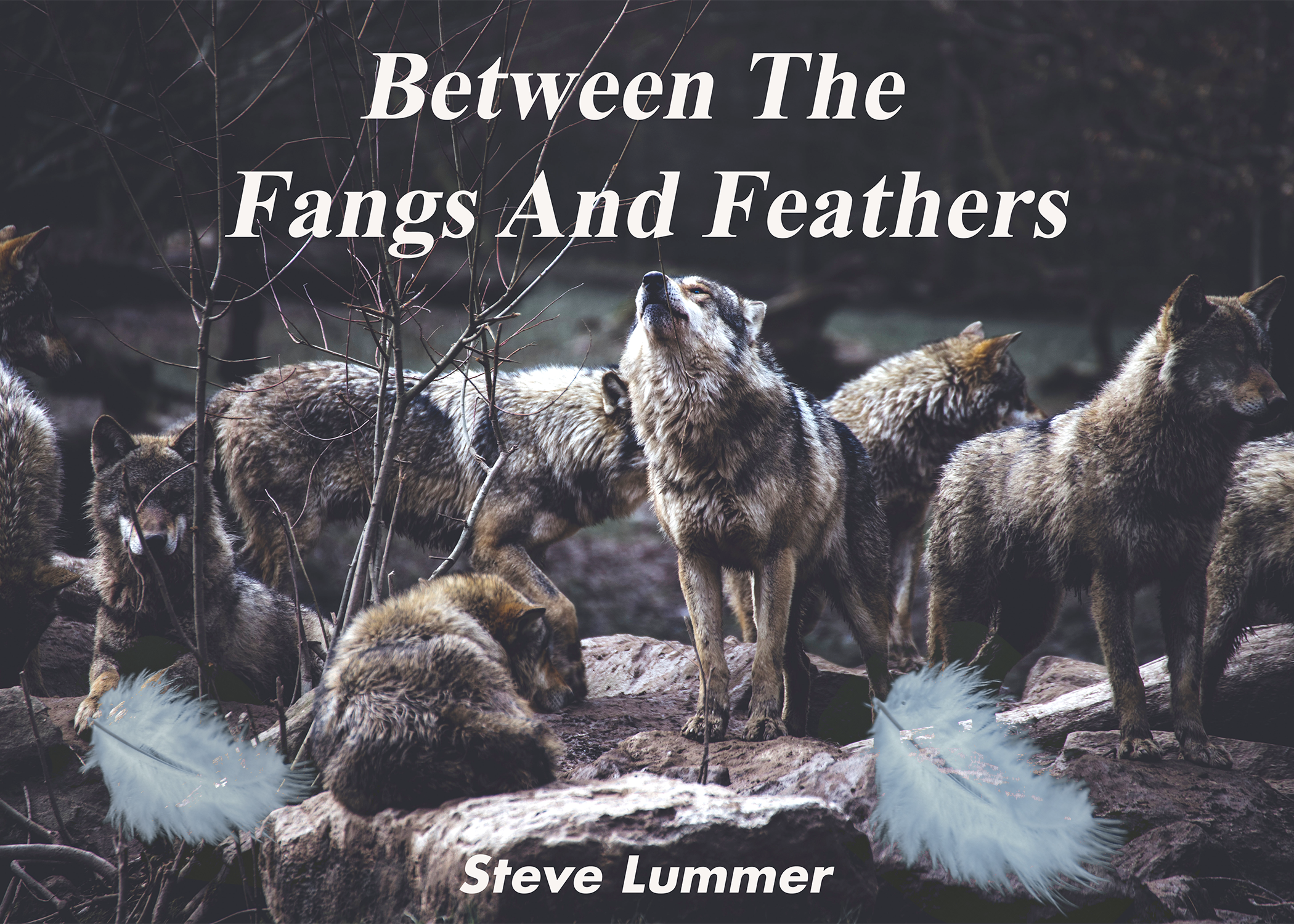
Between Fangs and Feathers How God uses the wilderness to shape and keep the identity we were meant to have. By Steve Lummer
“And he was with the wild animals, and the angels were ministering to him.” – Mark 1:13
Not long after Jesus was baptized by John, and not long after he heard his Heavenly Father say, “This is my beloved son, in whom I am well pleased” (Matthew 3:17, NIV), he was tested regarding his identity. Jesus provides a model for finding and keeping our true identity through his wilderness experience. For forty days, Jesus was tempted with the “if you are” challenges from the devil. Matthew, Luke, and Mark record this wilderness experience, where Jesus faced his challenges for forty days and nights.
Mark 1:9-13 (ESV): In those days Jesus came from Nazareth of Galilee and was baptized by John in the Jordan. And when he came up out of the water, immediately he saw the heavens being torn open and the Spirit descending on him like a dove. And a voice came from heaven, “You are my beloved Son; with you, I am well pleased.” The Spirit immediately drove him out into the wilderness. And he was in the wilderness forty days, being tempted by Satan. He was with the wild animals, and the angels were ministering to him.
Somewhere between the wild animals and the wisp of angels’ wings stood Jesus, alone, for forty days and nights. I like that Jesus spent forty nights of his life out in the wild with wolves. As Mark tells us, he was with the wild beasts.
I remember a vivid black night in the Irish wilderness, staring at the sky at 11:00 p.m. just before bedtime. I let the fire die down and adjusted my eyes to catch a glimpse of the Milky Way—a God-given star show on an Ozark night. But that wasn’t the only gift that dark night offered. As I scanned the horizon across the dark forest, I saw gleaming eyes like live coals. First one pair, then a second, then a third. A circle of narrow eyes surrounded my camp, appearing and disappearing, leaving me shivering in the silence. Wilderness places give us the opportunity to discover the person God created us to be.
We need to intimately know this Jesus who endured the wilderness, for it is the wilderness where we dwell. It’s in this terrain that the Holy Spirit, Satan, wild beasts, and angels all reside together. We can survive such a place only through companionship with the one who knows the way.
Mark, unlike Matthew and Luke, offers no extraneous details about Jesus’s wilderness experience. Instead, Mark presents us with a simple yet powerful image: “The Spirit immediately drove Jesus out into the wilderness. He was in the wilderness for forty days, tempted by Satan. He was with the wild beasts, and angels waited on him.” (Mark 1:12-13)
As I reflect on Mark’s version, three truths stand out:
Jesus was in the wilderness (Eremos), between the wild beasts and the angels.
What happens to you in the wilderness?
You find out how weak you are.
You find out how strong you are.
You find out who God is.
You find out who you are.
The wilderness, or Eremos in Greek, can be translated as a desert, deserted place, desolate place, solitary place, lonely place, quiet place, or wilderness. For this reflection, I’ll focus on the Eremos space that Jesus was led to by the Holy Spirit—a place where, as Mark 13 shows, Jesus was between the things of this earth and the things of heaven.
“He was with the wild beasts, and angels waited on him.” – Mark 1:13
Jesus was between the fangs of the wild beasts that could have distracted him and the feathers of the heavenly host that ministered to him. He was literally between the fangs and the feathers. The Celtic Christians have a term for such experiences: “thin places.” These are rare locales where the distance between heaven and earth collapses.
Thin places are locations where the veil between heaven and earth is nearly translucent, offering us glimpses into another realm. This idea often refers to mountaintops or other physical locations, but it also signifies spiritual closeness. When we face trials, eternity feels nearer, and the kingdom becomes more visible if we choose to look closely.
Over the past several years, more articles on thin places have appeared. Eric Weiner’s essay “Where Heaven and Earth Come Closer” in the New York Times (2012) and Oliver Burkeman’s “Where Heaven and Earth Collide” in the Guardian(2014) explore this concept rooted in Celtic spirituality. They describe thin places as locations where we catch glimpses of the divine or the transcendent.
The thin space of the wilderness can confuse and feel like a crisis. We lose our bearings and find new ones—or we don’t. Either way, we are jolted into seeing the world differently. Thin places transform us, unmask us, and help us become our essential selves. In these places, the distractions of daily life are stripped away, revealing who God made us to be.
“And he was with the wild animals, and the angels were ministering to him.” – Mark 1:13
In Matthew’s account of Jesus’ wilderness experience, we see how the wilderness solidified Jesus’ identity and his mission.
Jesus’ identity was questioned and solidified in the wilderness.
I once heard a story of a middle-aged woman who had a heart attack and a near-death experience. Seeing God, she asked, “Is this it?” God replied, “No, you have another 43 years, 2 months, and 8 days to live.” After recovering, she decided to have cosmetic surgeries, figuring she might as well make the most of her extended life. After her final procedure, she was killed by an ambulance. Arriving before God, she asked, “I thought you said I had another 40 years?” God replied, “I didn’t recognize you…”
Most people live their entire lives as strangers to themselves. Don’t let that happen to you. The easiest thing to be is yourself. The hardest thing is trying to be what others want you to be. As John Mason once told me, “Steve, we are all born originals… don’t die a copy.” The wilderness dares us to be who we are meant to be. I believe Jesus’ temptation in the wilderness wasn’t just about turning stones to bread, jumping from a tower, or worshipping the devil. His temptations were about becoming the person his Father needed him to be.
Many Bible scholars suggest that the specific temptations Jesus faced in the wilderness represent three main categories of all human temptation. The apostle John labeled these as “the lust of the flesh, the lust of the eyes, and the pride of life” (1 John 2:16, NIV).
The three tests of Jesus’ identity in Matthew 4:1-11:
The first test is the test of choosing an identity of self or “the lust of the flesh.”“The tempter came to him and said, ‘If you are the Son of God, tell these stones to become bread.’ Jesus answered, ‘It is written: Man shall not live on bread alone, but on every word that comes from the mouth of God.’” – Matthew 4:3-4
The second test is the test of choosing an identity of materialism, or the “lust of the eyes.”“Then the devil took him to the holy city and had him stand on the highest point of the temple. ‘If you are the Son of God,’ he said, ‘throw yourself down. For it is written: “He will command his angels concerning you, and they will lift you up in their hands, so that you will not strike your foot against a stone.”’ Jesus answered him, ‘It is also written: Do not put the Lord your God to the test.’” – Matthew 4:5-7
The third test is the test of choosing an identity of “the pride of life.”“Again, the devil took him to a very high mountain and showed him all the kingdoms of the world and their splendor. ‘All this I will give you,’ he said, ‘if you will bow down and worship me.’ Jesus said to him, ‘Away from me, Satan! For it is written: Worship the Lord your God, and serve him only.’ Then the devil left him, and angels came and attended him.” – Matthew 4:8-11
The wilderness is where we identify who we are and what our mission is.
“And he was with the wild animals, and the angels were ministering to him.” – Mark 1:13
Before beginning his earthly ministry, Jesus needed to know who he was and what his mission for the Father would be. Similarly, before we set out to fulfill God’s assignment for our lives, we must have a firm understanding of our identity and who God has made us to be.
“For we are God’s handiwork, created in Christ Jesus to do good works, which God prepared in advance for us to do.” – Ephesians 2:10 (NIV) “Each of us is an original.” – Galatians 5:26 (NIV)
Wilderness reveals the original you.
Wilderness and outdoor classrooms help us recognize defining life moments, both personally and collectively. A wilderness experience is crucial for encouraging and equipping the saints. A well-organized wilderness classroom opens our eyes in unique and inspiring ways. In the wilderness, we gain the heart to love God and others more deeply. Wilderness also helps us develop the skills needed to impact others with humble confidence. There are many opportunities right outside our doors to engage others with the wonder of God’s creation. With the proper structure, outdoor creation education empowers both teacher and learner in ways often unachievable in traditional classrooms.
Wilderness experiences help you do personal archaeology with fewer distractions. Wilderness places give us the opportunity to utilize solitude and silence, which in turn provides a setting to minimize life’s distractions and immerse ourselves in God’s presence within His creation.
Wilderness and adventure experiences help you decide to be yourself. Just as Jesus was tempted to sell out for something less than his Father’s design for his life, we too can discover our unique purpose in wilderness places. The wilderness strips away our false selves and reveals who our Creator designed us to be.
You owe it to God and yourself to be yourself.
“For we are His workmanship, created in Christ Jesus for good works, which God prepared beforehand, that we should walk in them.” – Ephesians 2:10 (NIV)
There has never been and never will be another you. Your wilderness defines you. It shapes you. It helps create you—through pain, hardship, and confusion. It is your wilderness, and no one else’s. Between the wildness of earth and the wisdom of heaven, we discover who we are and what we are here for. When we find our “why” in the wilderness, we will always find our way.
Wilderness, as Michael Easter points out in his book The Comfort Crisis, addresses what he calls “Western laziness”: “It consists of cramming our lives with compulsive activity, so there is no time to confront the real issues… If we look into our lives, we will see clearly how many unimportant tasks, so-called ‘responsibilities,’ accumulate to fill them up. Going on as we do, obsessively trying to improve our conditions, can become an end in itself and a pointless distraction.”
Michael Easter continues: “But there are a lot of great pleasures you can get out of the experience of being alone with yourself. In solitude, you can find the unfiltered version of you. People often have breakthroughs where they tap into how they truly feel about a topic and come to some new understanding about themselves. Then you can take your realizations into the social world. Building the capacity to be alone probably makes your interactions with others richer because you’re bringing to the relationship a person who’s actually got stuff going on inside, and isn’t just a connector circuit that only thrives off of others.”
Research backs up solitude’s benefits—it improves productivity, creativity, empathy, and happiness while decreasing self-consciousness.
God uses the wilderness to shape and maintain the identity we were meant to have. Do not lose your God-given identity in this self-important, synthetic, and sensually-driven culture. It’s time to trade in our fleeting worldly identity for one that is eternal. Do not be afraid to place your identity in Him. God is present in your wilderness, and you were made in His image. Quiet yourself in God’s creation.
Or, as Oscar Wilde said: “Be yourself. Everyone else is already taken.”
“And he was with the wild animals, and the angels were ministering to him.” – Mark 1:13
It was 11:15 PM! My camp was pitched just outside the Grand Canyon National Park on BLM land (Burerau Of Land Management). The National Park has some great camping spots and this time of year they are so overpopulated. For this trip I’m allergic to crowds; yipping Chihuahuas diesel pickups and teenage “music”. This trip will require solitude, silence and a really good campfire.
In the past I have had many campfire chats in my forty plus years of pastoral ministry. The fellowship was always warm. Many times the fire soon cooled and the friendships burned out for one reason or another. We heard in our campfire conversations over the years the phrase, “I remember once”. We talked about the only things ever discussed around campfires – old times and stories told by faces reflected in the fires. Yes! Nature’s T.V. held us captive throughout the evening chats.
My adventure practice this past week was about reflecting on those campers in the fire that are no longer with me. Some, for reasons that cause relationships to cool and others that left my life in very heated disagreements. I had three campfires on this adventure and I called each of them “Fires Of Forgiveness”.
My first campfire of forgiveness:
“Our God is a consuming fire.” Hebrews 12:29 (NIV)
Fire consumes, wipes out and cleanses. I needed to be cleansed of the battle wounds I had received over the years of ministry. I needed this adventure to not only free me from some past hurt, but to get free me deep in my soul. What I discovered is that I invested a lifetime in building a great ministry but didn’t take the time to build a great soul. What? Yes, there I said it. I was more interested in how Richard Rohr so artistically writes. “There are two major tasks in the human spiritual journey. The task of the first half of life is to create a proper container for one’s life and answer some central questions. “Who am I?” “What makes me significant?” “How can I support myself?” “Who will go with me?” The task of the second half of life is, quite simply, to find the actual contents that this container was meant to hold and deliver. In other words, the container is for the sake of the contents.”
An authentic God experience always “burns” you, yet does not destroy you. It burns away the layers of my false self and get to the true identity of who my creator designed me to be.
The burning bush example revealed to Moses who he was and what God designed him to be (Exodus 3:2-3). I was not prepared in Bible College or in ministry for such burning, nor was I even told to expect it. By definition, authentic God experience is always “too much”! It consoles our true self only after it has devastated our false self. I need this first fire to be a fire of forgiving myself of focusing on my container too much and not the contents.
Belden C. Lane in his book, Backpacking With The Saints writes of the Desert Fathers and how they spoke with insight of how their inner wounds and their old injuries from the past will have a way of expressing themselves. Abba Poeman observed that old wounds have a way of expressing themselves in four stages of unconscious activity. They first appear in the heart, as festering wounds that crop up in our dreams and fantasies. They subsequently show up in the face, in passing glances of anger, jealousy, or envy. Abraham Lincoln said that everyone over forty years of age is responsible for his own face. It mirrors what we carry inside. Thirdly said Abba Poemen, inner wounds reveal themselves in words, in our sniping at others, our passive-aggressive language. And finally, the wounds appear in deeds. We reface them in our actions, doing to others what had been done to us. What isn’t transformed, in other words will be transmitted.
At this campfire of forgiveness I learned to understand and put into the practice dying to my disturbed, over anxious self important self. The God who is a consuming fire did His work that night.
My second campfire of forgiveness:
The second evening in solitude I built another campfire. They never told me in Bible college that just because I had vision and wanted to help people find Jesus not everyone would support that vision or get behind it. The naivety of youth produced the misleading notion that people would just follow me. I know, what a silly notion! Silly as that is, over the long haul, when people leave you for one reason or another it does affect you. The chronic disappointment of watching your “friends” get up and leave your fire is troubling and I’m not just talking about the Covid convenience of people just quitting on you, I’m speaking to a deeper pandemic of disloyalty and abandonment.
NOT OF MY FIRE.
Over the years, my wife and I have had many great lasting relationships. The wealth of these relationships outweighs the ones that hurt. There is still a sadness that hovers when we feel the loss of people we poured our lives into . A scripture that has always kept me focused and is John 2:19 “They went out from us, but they were not of us; for if they had been of us, they would have continued with us; but they went out that they might be made manifest, that none of them were of us.”- (NKJV)
Exit wounds or God’s protection?
When in the perils of brethren, it is good to remember quotes like this one.
“God sometimes removes a person from your life for your protection. Don’t run after them.”―Rick Warren
A good friend explained it to me like this, “Steve, when you plant a church you will have people that will help you start the work and then they are gone. Think of it like rocket boosters on a space shuttle. They get you to a certain point and then they fall off for a reason. God sent them to you to accomplish His work for a certain season.
“The Lord gives and He takes away.” Job 1:21
When I paused and looked at the glowing embers that night, I realized that none of the people in “my church” were my people in the first place. They were God’s people and it is His church.
It was a relief to forgive the old me of thinking everyone needed to stay with me.
I concluded that not everyone you lose is a loss. What a privilege it was for me to serve with them in the warmth of the fire while we had it.
My Third Campfire Is a Restoring Campfire:
The third evening I sat next to the best campfire I have ever enjoyed. I’ll name it the campfire of restored identity. I mused on the two times in scripture where Peter was close to a campfire and the smell of that wood smoke saturated the air. The two references are where Peter denied Jesus in a courtyard and the second is where Jesus restored Peter next to a fire on the beach.
When they landed, they saw a charcoal fire there with fish on it, and some bread. – John 21:9
The first time is in John 18:15-19. Peter stood and warmed himself while denying that he even knew Jesus.
“Simon Peter and another disciple were following Jesus. Because this disciple was known to the high priest, he went with Jesus into the high priest’s courtyard, 16 but Peter had to wait outside at the door. The other disciple, who was known to the high priest, came back, spoke to the servant girl on duty there and brought Peter in.
17 “You aren’t one of this man’s disciples too, are you?” she asked Peter. He replied, “I am not.”
18 It was cold, and the servants and officials stood around a charcoal fire they had made to keep warm. Peter also was standing with them, warming himself.”
When they landed, they saw a charcoal fire there with fish on it, and some bread. – John 21:9
Sitting next to a charcoal fire, Jesus restored Peter and his God-designed identity, as well as, his role as Jesus’ disciple and a leader of Jesus’ church. There the smell of campfire smoke brought memories of sin and guilt, and Jesus gave Peter grace and mercy. As fire is used to refine gold and silver, fire here is used to refine and restore Peter.
Coals and Conclusion:
Our “God is a consuming fire.” Hebrews 12:29 (NIV)
As we allow him to burn up the clutter of unforgiveness we experience freedom in our lives. The adventure of forgiveness lightens our load and removes the unneeded baggage that weighs our souls down. Start a fire in you life and let God burn up what you no longer need.
Here we are at December 21 and the winter solstice that marks the shortest day and the longest night of the year. The sun appears at its lowest point in the sky, and its noontime elevation appears to be the same for several days before and after the solstice. Hence the origin of the word solstice, which comes from Latin solstitium, from sol, sun and stitium, a stoppage. Following the winter solstice, the days begin to grow longer and the nights shorter.
Your solstice could be the darkest night of your life. The time when you feel like cannot see your way through.
Here are a few thoughts on seeing through your darkest times of your life.
Usually God’s purposes are revealed and His power displayed, in our darkest experiences when like Gideon you ask, “If the Lord is with [me], why has…this happened?” When there seems to be no rhyme or reason, God’s promise is, “I will give you the treasures of darkness, riches stored in secret places, so that you may know that I am the Lord…who [calls] you by name” (Isa 45:3 NIV).
Anybody can be faithful in good times, but standing “by night in the house of the Lord” (Ps 134:1 NIV) takes real commitment. Hymn writer George Matheson wrote: “Will I remain in God’s house at night…love Him for who He is…know I desire not the gift but the Giver? When I can remain…during the darkness of night and worship…I’ve accepted Him for Himself alone.” When the Israelites faced their greatest challenge, the Red Sea, the Bible says, “All that night the Lord drove the sea back” (Ex 14:21 NIV). Be encouraged, God is working, even though you can’t see Him.
After all, how can God give us “songs in the night” (Job 35:10) if the sun always shines? Jesus said, “What I tell you in the dark, speak in the daylight” (Mt 10:27 NIV). It’s in life’s dark places that God shares things which strengthen you, and encourage those around you.
The Solstice or darkest night of your life can be an opportunity to see what you cannot see in the bright of day.
Take the darkest places and let God transform them into your brightest places.
Weeping may remain for a night, but rejoicing comes in the morning. Psalm 30:5
Be the light my friends and especially in the darkest places.